
Products


This pattern is from John Carwitham's 1739 book, Various Kinds of Floor Decorations. The pattern was chosen for the entry and back hall of the Bedford House, the main residence at the John Jay Homestead in Katonah, New York, which is currently undergoing renovation.
John Jay occupied the house from 1801, upon his retirement, to 1829 when he died. Of all the Founding Fathers, no other filled so many high offices. John Jay served the State of New York as a principal author of its first constitution in 1777, and as its first Chief Justice. He served the nation as President of the Second Continental Congress, Minister Plenipotentiary to Spain during the Revolutionary War, and Secretary for Foreign Affairs under the Articles of Confederation. He was author and key negotiator, with Benjamin Franklin and John Adams, of the Treaty of Paris, which ended the American Revolution. With Alexander Hamilton and James Madison, he wrote the Federalist Papers, arguing for adoption of the United States Constitution. After the ratification of the Constitution, President Washington appointed Jay the first Chief Justice of the United States.
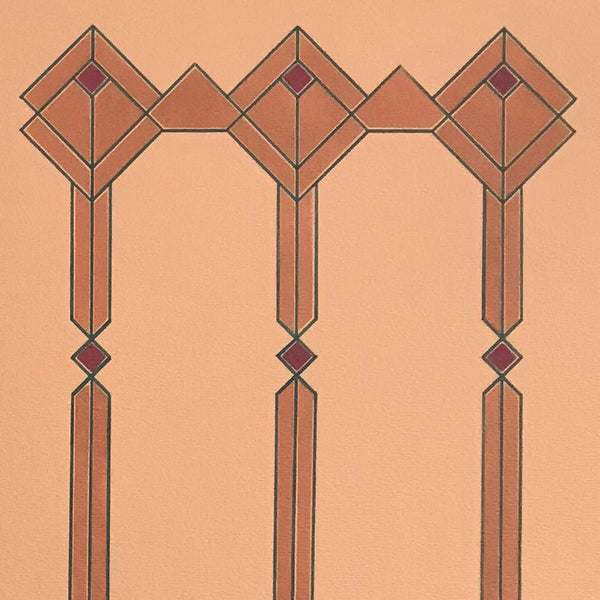

This design is based on a leaded glass pattern in the 1907 home of Portland clients and is found in windows throughout the main floor of the house.


This design is based on a wallpaper pattern, c. 1886, from the A.W.P.M.A. (American Wallpaper Manufacturer’s Association) and attributed to M.H. Birge and Sons, the premier American wallpaper manufacturer of the time. This paper is in Bolling & Company’s portfolio, the largest collection of antique American wallpaper in private hands. AGD’s co-owner, Gwen Jones, is also a co-owner of Bolling & Company and intends to mine their archives for other suitable patterns to adapt for floorcloths. This one was top of the list!


This is a terrific border pattern which has strong geometric leanings and a somewhat whimsical leaf pattern.


This completely original pattern features a classic repeating diamond array that contains a border with an Early American-style lozenge and honeycomb display, surrounding an organic medallion. The colorway is reversed on every other diamond. The pattern is a replica of one of the oldest existing floorcloths in the US (c 1848), residing at Melrose, a National Park location in Natchez, Mississippi.
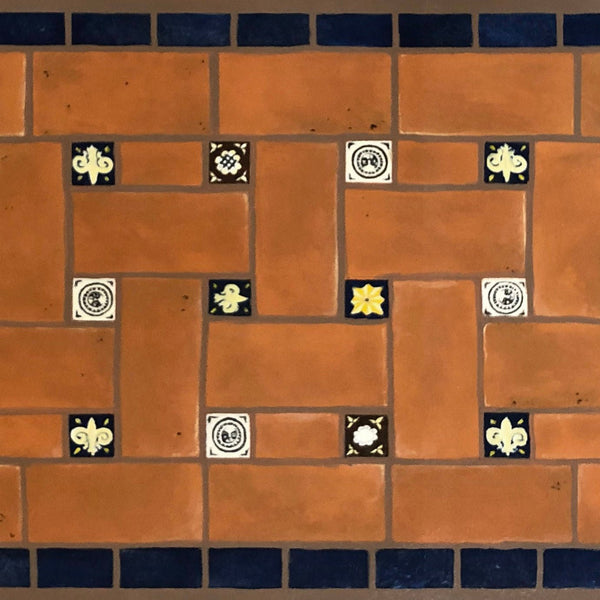

This design was inspired by inlaid Mexican Tile in our client's entry. The client loves the tile and wanted the same look in their kitchen.


This pattern was inspired by Armstrong's Spatter linoleum c1950s. The client's grandmother had the red version in her kitchen. We decided to add a celestial overlay of stars which ended up looking, to us, like the Milky Way.
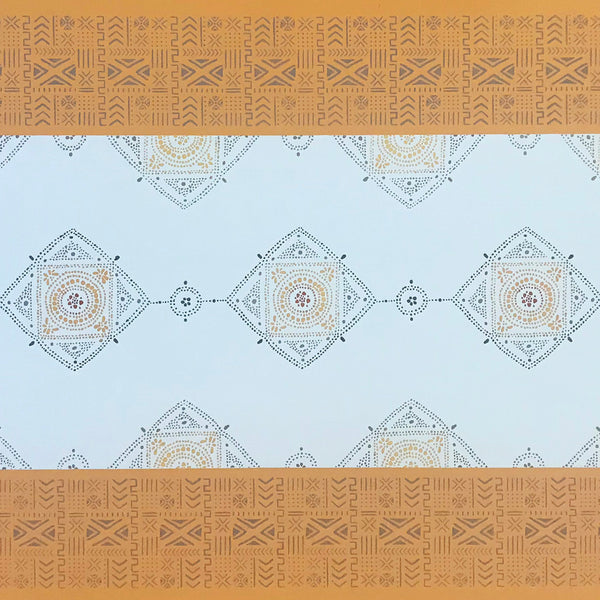

This floorcloth employs a mudcloth pattern (a traditional African textile design) for the border and combines it with a lovely, tribal-inspired medallion that shares a similar design language.


This lovely, understated, organic pattern made up of floral elements that combine to create circles, is based on an original linoleum pattern from about 1910 or so. We are completely charmed by the pattern and look forward to exploring it in many different colorways and treatments.
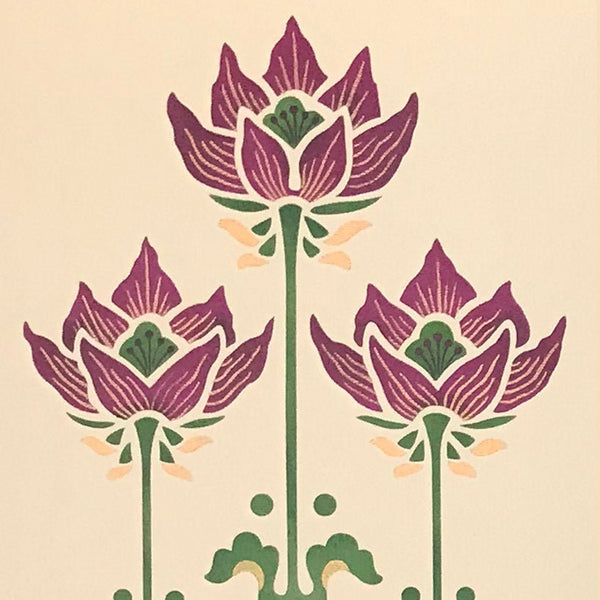

This poppy pattern is taken from Plate XXXVII in Christopher Dresser's "Studies in Design", c. 1875. The description of the plate is "Sheet of powerdings, adapted for wall-ornaments." Well, off to the dictionary to learn that powderings are (in this context) "Decoration by means of numerous small figures, usually the same figure often repeated." We originally turned this motif into a stencil for a wall ornament for a client's kitchen.


Rufus Porter (1792-1884] was an artist, musician, teacher, inventor, and founder of Scientific American magazine. Porter began his artistic life as a decorative painter. He moved on to portraits and later began painting the murals that made him famous. He painted what he knew — landscapes depicting the farms around Bridgton, Maine, his childhood home, and seaport scenes of Portland, Maine, where he lived and studied as a young man. His style is very recognizable.


This fabulous, unusual linoleum pattern was discovered around 2010 when a scrap (shown in the photos) was found at the base of a dumbwaiter during a kitchen renovation in Portland, Oregon's Ladd's Addition. The homeowners commissioned a floorcloth in the pattern.
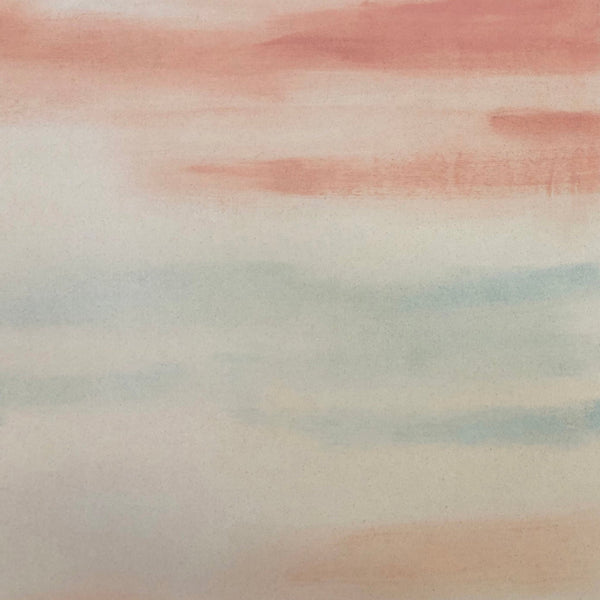

This design for this floorcloth is based on a 5" x 7" watercolor provided by an interior designer. The lovely, little watercolor depicts an abstract sky.


This is the first Dresser pattern we worked with, clearly seeing how it could be adapted to stencils and how great it would be for a custom floorcloth design. We loved the original Dresser palette and the first piece we made with the pattern, a rather complicated U-Shaped design, employed this colorway. Several additional colorways have been explored as have different shapes, all working beautifully in this versatile design.
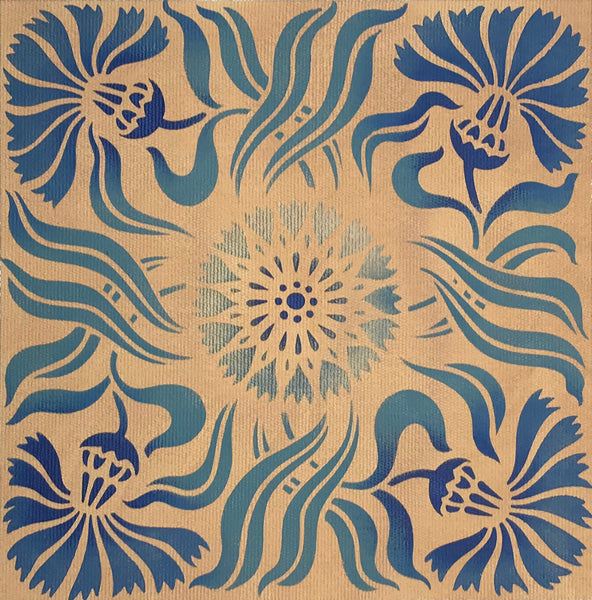

This pattern is from The Stencil Library, a great source for a wide variety of stencils in varying styles. We chose this one for its arts & crafts bent and look forward to trying it with different placements of the tiles and assorted palettes.


This floorcloth is based on an ornate floral damask design that creates a trellis effect. The border is an organic leaf and berry motif, deliberately given a worn effect, and the corners are hand-painted fruits based on carvings on the buffet in the room where this floorcloth resides.
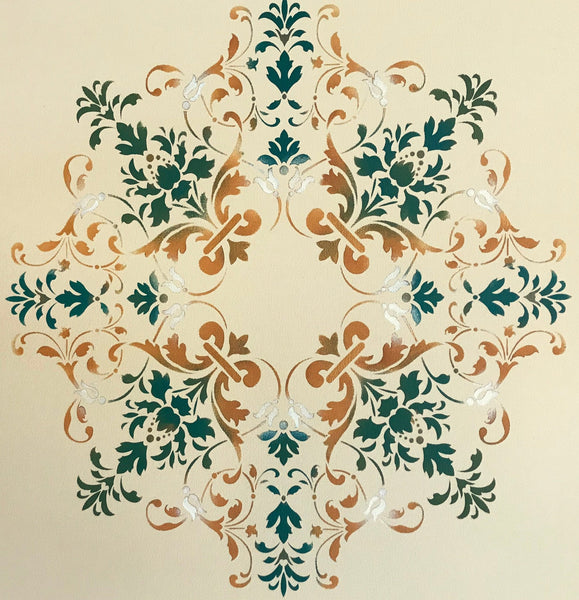

This pattern is based on a series of classic European stencils from the early 1900s designed for ceilings. Great ceiling designs are often great rug designs. The scrolling pattern and floral motifs are lovely and the set includes a center medallion, corners, and side stencils all incorporating the same decorative elements.
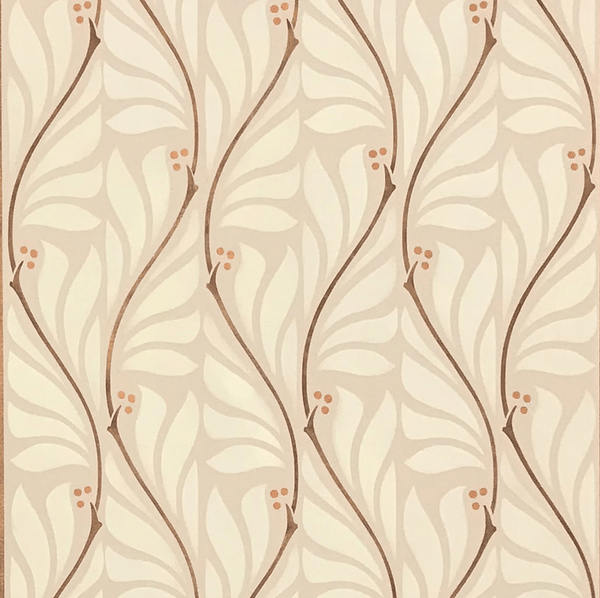

This floorcloth is based on another terrific stencil from The Stencil Library. Is it Arts & Crafts or does it have more of a 70s vibe? It is somehow both organic and stylized simultaneously. The undulating vines, the leaves, the berries...simple, yet complex. For us, at least, it is an enigma.
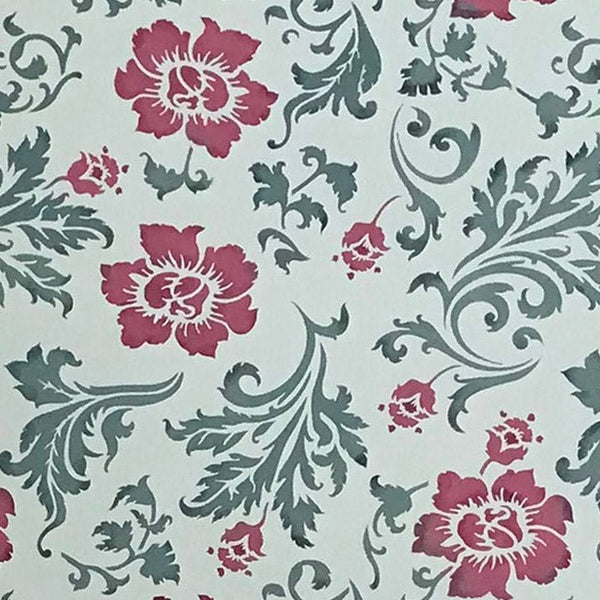

This lovely all-over floral pattern that is organic in its execution, creating a carpet of blooms, buds, and leaves.